


In 2022, as the COVID-19 pandemic swept across China, items flying off the shelves included not only Lianhua Qingwen and ibuprofen, but also tinned yellow peaches. Several medical experts cautioned that tinned yellow peaches cannot alleviate disease symptoms, and should particularly be avoided when coughing as they may exacerbate symptoms. Gao Xiaoling, Deputy Director of the Department of Respiratory and Critical Care Medicine at the Second Hospital of Shanxi Medical University, stated that consuming fruit cannot replace medical treatment. If diagnosed with COVID-19, one must undergo treatment with scientifically prescribed medication. When symptoms are severe, one should actively seek hospital treatment and cooperate with doctors for scientific management of the illness. A canned brand debunked the rumour on social media, stating that yellow peach preserves themselves have no medicinal effect whatsoever. Netizens retorted: ‘How could we not know if these tins have medicinal properties? You clearly don’t understand yellow peach preserves.’
The ‘mystical properties’ of yellow peach preserves originate in Northeast China. There, they are affectionately dubbed the ‘medicine god’ – the distinctive disinfectant aroma paired with the yellow flesh in glass jars forming a childhood memory for every Northeasterner. ‘The yellow peach preserve deity protects every Northeasterner far from home.’ In the region, these preserves serve as essential medicine cabinet staples, though this ‘superstition’ remains incomprehensible to Southerners. Of course, it holds no medicinal properties. Yet to Northeasterners, falling ill without a chilled jar of peaches feels utterly unacceptable. ‘You wouldn’t understand Northeastern joy—hoarding peach preserves isn’t about curing ailments.’ This peculiar reverence stems from the region’s climate and decades-old habits. In the city, central heating keeps homes warm; in the countryside, heated brick beds maintain high temperatures. On cold winter days, a chilled jar of sweet peaches offers welcome relief. It’s also an indispensable festive staple: ‘The true measure of a splendid feast lies in whether you end with this jar.’ In Northeast China, peach preserves have never faded from view.
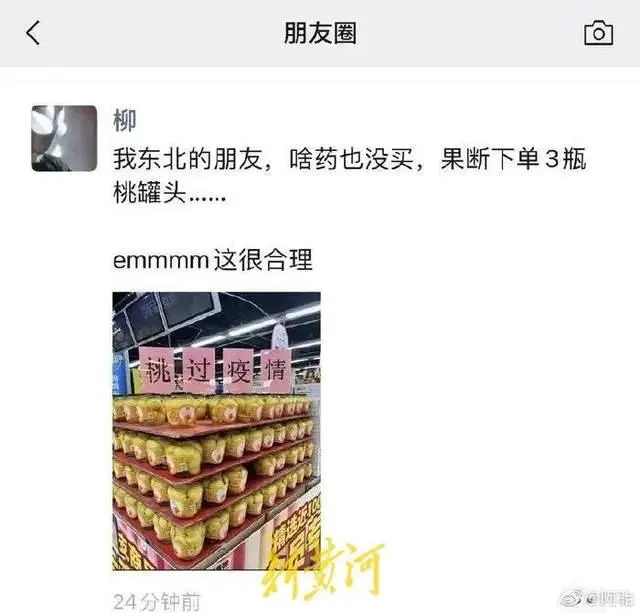
Canned yellow peaches continue to soar in popularity, sparking nationwide buying frenzies. In Dangfang Town, Pingyi County, Linyi City – hailed as China’s Fruit Canning Capital – orders for canned yellow peaches have surged dramatically at local factories. Manufacturers assure ample stock, urging consumers against hoarding or scrambling for supplies. Yet this has done little to dampen online enthusiasm. ‘Not buying any medicine, just ordering three tins of yellow peaches – mates reckon that’s perfectly reasonable.’
In the 1970s and 1980s, canned yellow peaches were still considered “luxury items”. Beyond special festive occasions, ordinary households rarely indulged in them. Children were only granted a jar of tinned yellow peaches when they were ill. For those born in the 1980s and 1990s, these peaches hold a special place in their memories. ‘The glass jars with metal lids, filled with yellow peaches, are a physical memory for those from Northeast China. When I had a fever as a child, my mother would go out in the middle of the night to buy me peach preserves. The peaches would cure my illness, and from then on, I viewed peach preserves through the rose-tinted lens of childhood.” The bright yellow flesh inside the glass jar became a cherished childhood memory. Children in Northeast China who grew up eating peach preserves developed a conditioned reflex: when ill, they would eat peach preserves. Northeasterners have particular packaging preferences when purchasing these preserves: ‘Opt for glass jars—they’re sturdier. Don’t discard the empty jar; save it for pickling garlic cloves.’
‘They hold no medicinal properties, yet possess a certain magic. Flaunting a jar of yellow peaches instantly lifts one’s spirits, hastening recovery,’ explained Northeast clients to Miao Sen, illustrating the preserves’ remarkable popularity locally. ‘They say some pharmacies list peach preserves alongside medicines online, with several selling out completely.’ When stocking up on remedies, people routinely grab a few tins. Those temporarily unable to obtain medicine view the preserves as a ‘substitute.’ ‘It’s psychological comfort—just having them there brings peace of mind.’
The preserves offered psychological solace. For those too ill to eat, the peaches provided vitamin supplementation. Some netizens reasoned that during illness, being able to swallow fruit offered energy to combat viruses – hardly a bad thing.
Childhood canned yellow peaches preserves seemed capable of curing all ailments. A spoonful of their cool, sweet, and smooth texture could instantly dissolve all discomfort.